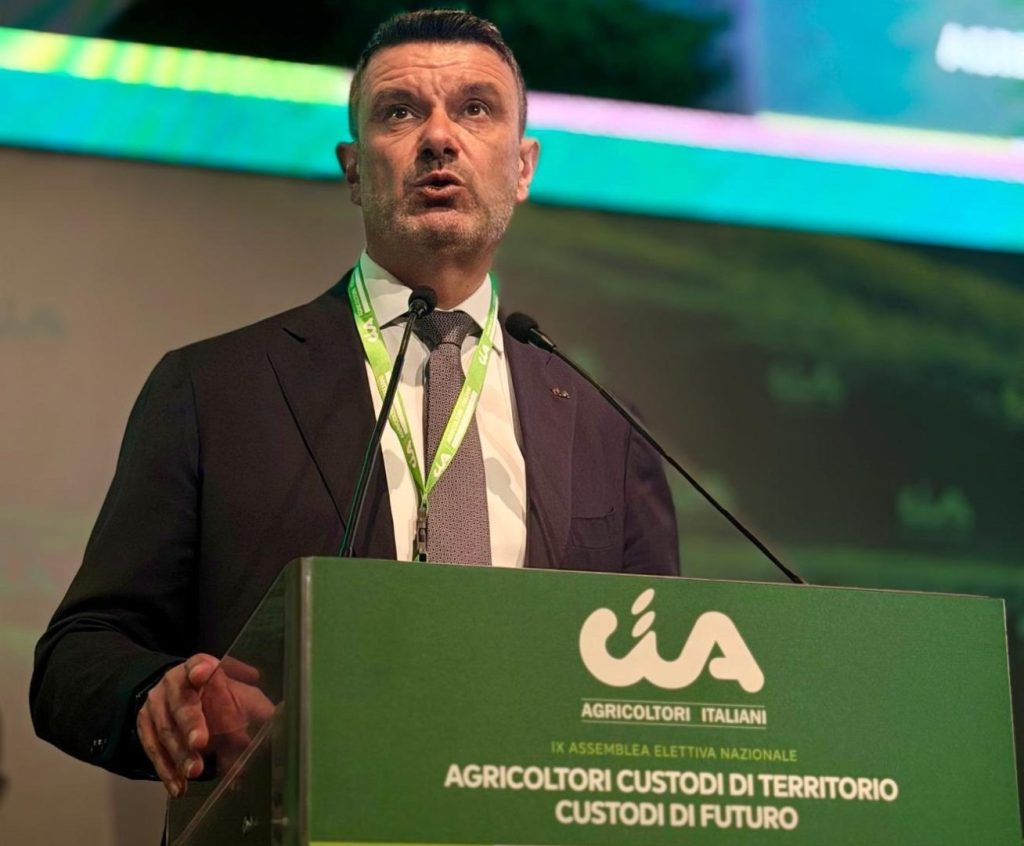
Fini has been leading the organization since 2022, after serving as the regional president of Cia Emilia-Romagna from 2018 and, previously, of Cia Modena. “I thank everyone for their trust and embrace this reappointment with great pride and a deep sense of responsibility,” stated Fini immediately following his reelection. “In a time marked by wars, climate crises, and global economic tensions, agriculture is not a marginal sector but a pillar of national security, social cohesion, and the country’s future.” The president then emphasized the need for a paradigm shift: “We demand that agriculture be regarded as a genuine strategic asset because food sovereignty is the foundation of a people’s freedom: a people that cannot feed itself is a people that can be blackmailed.”
Today, “the challenges are immense” -Fini added- “but our mission is to transform fear into energy for change and to defend farmers as guarantors of food, sentinels of quality, custodians of the land, and architects of the country’s future.” With the aim of “building an Italy where staying in the countryside is not a curse, but a proud and worthy choice for future generations.”
In his address, the president of Cia covered multiple points and issues, outlining the main directions of intervention for the organization. The international scenario is now a genuine “permanent storm.” Following the war in Ukraine, the tragedy in Gaza, and the increasingly dangerous escalation in the Middle East, the world finds itself hostage to new energy blackmails over the Strait of Hormuz, with severe repercussions on global economic balances. A context which, as highlighted by the FAO alarm, risks pushing over 45 million people into a state of acute food insecurity, severely affecting businesses, families, and production systems. “Agriculture is the first sector to feel the shockwaves of conflicts” – Fini reminded – . Agricultural diesel prices skyrocketing (+100%), fertilizers out of control (urea +43% and ammonium sulfate +20%), and a surge in costs throughout the supply chain.” Therefore, at the community level, rapid, strong, and extraordinary responses are needed, similar to those during Covid. For fertilizers, direct support is required starting in 2026, suspension of import tariffs, revision of the CBAM, which risks incurring further costs, better controls against speculation, and unlocking of digestate currently hindered by regulatory constraints. Meanwhile, on the energy front, exceptional measures are needed even beyond the constraints of the Stability Pact, common purchases to reduce prices, and prioritization of agriculture, excluding food production from any rationing plans. “European food security must be safeguarded with courageous and coordinated policies” – underscored the Cia president – recognizing the primary sector as an essential infrastructure for economic, social, and democratic stability on the continent.”
Among the goals of Fini’s new mandate, the need to rebalance value across the agri-food supply chain stands out, which is currently heavily unfavorable for farmers. This is a historical battle for Cia, implementing a strategy in three key directions. The first is to enhance the collective strength of producers through aggregation (consortia, Aop), vertical integration, shared projects, youth inclusion, and strengthening interprofessional tools to define clear agreements and standard contracts with honest rules and fair remuneration. The second focuses on legality and transparency, with demands for chain certification systems, an effective prohibition on below-cost sales, combating unfair practices, and structural price monitoring through the establishment of an Institutional Portal. The third direction aims at a new pact with citizens, based on principles of health and sustainability, promoting all forms of short supply chains starting with local shops and farmers’ markets, and considering incentives for the consumption of Made in Italy products. “The intent is to ensure a fair income for businesses” – explained the president – and to elevate the farmer from a mere supplier of raw materials to an influential and equal partner in the supply chain.”
For Fini, the climate crisis is an inexorable reality that demands a structural response. Droughts, floods, water emergencies, and soil loss directly threaten Italy’s productive capacity. Regarding water, Cia is reviving the Water Caravan, a confederal project that maps critical issues and good practices in each region, and especially the “100 Good Works” Plan, which goes beyond traditional lists of interventions to instead identify a precise set of actionable projects determined through direct reconnaissance in the territories. There is also a need to accelerate the construction of storage basins, enhancing efficiency in networks (currently losing 40%), precision irrigation, and the role of rural energy communities, which the Confederation wants to help create and support through its dedicated foundation, EnerCia. Concerning soil, the need for legislation against indiscriminate consumption, safeguarding fertility, recovering abandoned land, and protecting agricultural areas has been reiterated. Strengthening insurance and mutual systems against climate and market risks is also central. On the topic of ecosystem services, Cia calls for a single incentive mechanism for carbon farming, biodiversity, and hydro-geological maintenance “because the farmer who protects the environment must be rewarded,” emphasized Fini. Innovation and research are also strategic, beginning with the much-awaited approval of the European regulatory framework on NGT, to ensure productivity and climate adaptability.
The revitalization of internal areas starts from a fundamental principle, the right to remain, which needs to be translated into concrete policies against depopulation and marginalization. According to the president of Cia, a paradigm shift is required to recognize rural areas not as a periphery, but as a crucial component of the country. In this context, “the farm is called to evolve into a true hub of territorial services, integrating production, tourism, welfare, energy, environment, and social services” and thus, Fini stressed, “we believe a new figure must emerge, the territory manager, an agricultural entrepreneur capable of providing multiple services, activating networks, interacting with institutions and communities, and generating local development.” However, this transformation requires significant investment in training: “We need to create a permanent school for farmers to train human capital. Specialist courses are needed on AI and big data, and we want to train rural digital tutors within the Cia system.” Yet, no system can sustain itself without a network of essential services. The gap between urban areas and internal regions must be closed and, to do so, the following are necessary: digital connectivity, which is not optional but an enabling service; proximity healthcare, investing in territorial medicine and telemedicine; schools and education as community anchors; housing policies with incentives for youth to attract new residents; and tax benefits with a dedicated ZES.
The CAP remains the historical pillar of European integration and “we are determined to defend it” – reiterated the president of Cia – “as a fully common and autonomous policy, with a stable, indexed budget adequate to new challenges.” Following mobilizations in Brussels and Strasbourg, “we succeeded in obtaining more resources” and, just last week, in light of the geopolitical situation, “the EU Parliament called for a 10% increase in the 2028-2034 budget, with positive impacts on CAP funds as well.” For Fini, this is the right direction, although the battle is not over yet: “We firmly say no to any attempts at renationalization or merging the CAP into an indistinct Single Fund, as this would mean fragmenting resources, increasing the risks of cuts, and endangering European food security.” A stronger CAP, however, must also ensure simplification, fair income, and concrete support for the most vulnerable businesses. “The CAP is not an expenditure, but a strategic investment that must restore dignity and prospects to those who make a living from agriculture,” reiterated Fini. On the topic of international trade agreements, another central issue, Cia demands full reciprocity and strict protection of the EU market. “We cannot accept agreements that open the doors to products made with lower environmental, social, and health standards than ours” – continued the president – “this is not free trade, but unfair competition.” With Mercosur and US tariffs, a strong, unified European trade policy capable of truly protecting the agri-food supply chain is needed. “International agreements must open markets, not close businesses,” Fini concluded.
– photo press office Cia-Agricoltori Italiani –